 WhatsApp: +86 16626708626
 Email:
  Phone: +86 16626708626
Description
Key Technical Specifications
| Parameter | Specification |
| Board Function | Turbine Speed Protection (SPRO) |
| System Compatibility | GE Mark VI Control Systems |
| Input Channels | 3 Magnetic Pickup (MPU) Inputs |
| Hardware Revision | H1A |
| Redundancy Support | Simplex or TMR (Triple Modular Redundant) |
| Terminal Type | Direct screw compression terminals |
| Pulse Frequency Range | 2 Hz to 20 kHz |
| Operating Temp | -30 to +65°C (-22 to 149°F) |
| Mounting | DIN-rail or cabinet wall mount |
Product Introduction
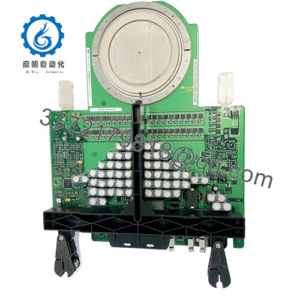
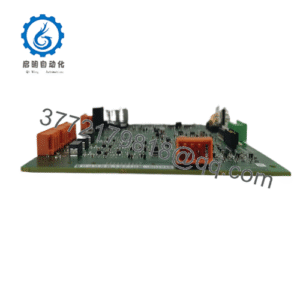
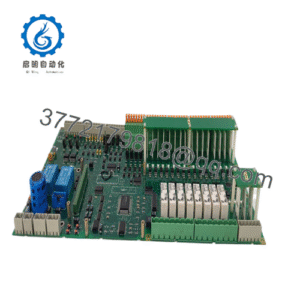
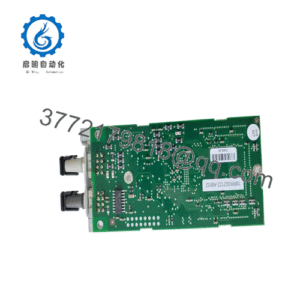
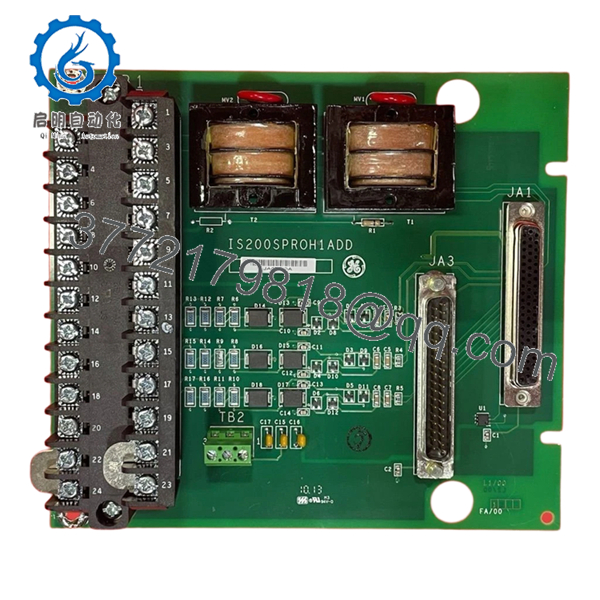
The GE IS200SPROH1A is a specialized Speed Protection (SPRO) terminal board within the Mark VI Speedtronic ecosystem. It acts as the critical hardware layer for emergency overspeed protection, interfacing directly with magnetic pickup (MPU) sensors to monitor turbine shaft speed. In a Triple Modular Redundant (TMR) configuration, the SPRO board fans out speed signals to the R, S, and T controllers, ensuring that a single component failure cannot result in a loss of protection.
Engineers favor the IS200SPROH1A for its rugged, passive design. Since it lacks active processing chips (which are housed on the associated VPRO processor card), the SPRO board is exceptionally reliable in high-vibration and high-temperature environments near the turbine base. This H1A revision is the industry standard for Mark VI speed sensing, providing a clean, noise-filtered signal path essential for preventing catastrophic mechanical overspeed events.
Installation & Configuration Guide
Stage 1: Pre-Installation Preparation (Estimated Time: 10 mins)
- ⚠️ Safety First: This board is part of the Emergency Trip System (ETS). Do not attempt replacement while the turbine is online. Ensure the system is in a “Forced Off” or “Mechanical Lock” state to prevent accidental trips or fuel valve closures.
- Tools Required: 1/8″ flathead screwdriver for terminals, ESD wrist strap, and digital tachometer (for post-install verification).
- Wire Labeling: Before disconnecting, verify that all MPU signal wires are clearly labeled. Reversing polarity on magnetic pickups can lead to erratic speed readings or “Signal Loss” alarms.
Stage 2: Removing the Old Module
- De-energize the Mark VI cabinet’s I/O power.
- Photograph the wiring harness. Note the shield grounding terminations; improper grounding on an SPRO board is the #1 cause of “ghost” speed spikes.
- Loosen the terminal screws and remove the wiring.
- If DIN-rail mounted, use a small screwdriver to release the plastic locking tab at the bottom of the board and lift it away from the rail.
Stage 3: Installing the New Module (Estimated Time: 15 mins)
- Physical Inspection: Verify the gold plating on the connector pins is intact and free of oxidation.
- Snap the IS200SPROH1A onto the DIN rail. Ensure it is seated firmly and does not wiggle.
- Reconnect the MPU wires to the designated terminals.
- Shielding Check: Ensure the cable shields are landed on the correct ground bar as per your site’s original wiring diagram. Do not “pigtail” shields if possible; keep them short to minimize EMI.
- Self-Checklist: [ ] Terminals torqued, [ ] Shielding grounded, [ ] DIN rail locked.
Stage 4: Power-On & Testing
- Restore power to the I/O rack.
- Check the Mark VI Toolbox (or ToolboxST) software. Verify that the “Speed Signal Loss” diagnostic has cleared.
- With the turbine at “Turning Gear” speed, verify that the MPU pulses are being registered by the R, S, and T controllers.
- Overspeed Test: If site procedures allow, perform a simulated electronic overspeed test to ensure the trip relays associated with the SPRO signal are firing correctly.

- IS200SPROH1A
- IS200SPROH1A
Frequently Asked Questions (FAQ)
Q: Can I use the IS200SPROH1A for active (Proximity) probes?
A: No. The SPRO board is specifically designed for passive Magnetic Pickup (MPU) sensors that generate their own AC voltage. If you are using active probes that require a power supply (e.g., Eddy Current probes), you typically need a different terminal board variant that provides a voltage output.
Q: Is this board “Hot-Swappable”?
A: Technically, the Mark VI system allows for some I/O replacement while powered, but I strongly advise against it for the SPRO board. This card is tied to the emergency trip string. Swapping it live can cause a momentary signal drop, which the VPRO will interpret as a failure, triggering an immediate emergency shutdown (EST).
Q: What is the difference between IS200SPROH1A and the H1B revision?
A: The H1B is a later revision with minor updates to the terminal block material and trace routing for better noise rejection. In the Mark VI system, the H1A and H1B are functionally interchangeable. You can replace an H1A with an H1B without any software changes.
Q: My speed readings are “noisy” after installation. Did I get a bad board?
A: Unlikely. Most noise issues on SPRO boards stem from the MPU air gap or shielding. Ensure your MPU sensors are gapped correctly (usually 0.010″ to 0.030″) and that the cable shields are only grounded at one end (the cabinet end) to prevent ground loops.
Q: Does this board require a firmware download?
A: No. The IS200SPROH1A is a passive terminal board. It contains no microprocessor or EPROM. All “intelligence” resides in the VPRO or TPRO processor cards that the SPRO connects to. Just match the physical jumpers and you are ready to go.