WhatsApp: +86 16626708626
 Email:
  Phone: +86 16626708626
Description
Key Technical Specifications
| Parameter | Value |
|---|---|
| Model | CC-TAIN01 |
| I/O Function | High-Level Analog Input IOTA |
| Compatible I/O Module | CC-PAIN01 |
| Channel Capacity | 16 single-ended channels |
| Input Signal | 4–20 mA |
| Transmitter Type | 2-wire or self-powered transmitters |
| A/D Resolution | 16 bits |
| Input Scan Rate | 50 ms |
| Input Path | 4–20 mA through 200 Ω |
| Common-Mode Rejection | 70 dB, DC to 60 Hz |
| Normal-Mode Rejection | 20 dB at 60 Hz |
| Normal-Mode Filter | Single-pole RC, −3 dB at 6.0 Hz |
| Maximum Normal-Mode Input | ±30 V |
| Channel-to-Channel Crosstalk | −60 dB, DC to 60 Hz |
| IOTA Size | 6 inches |
| Redundancy | Non-redundant; CC-TAIN11 is the redundant counterpart |
Honeywell’s Series C I/O specification identifies CC-TAIN01 specifically as the non-redundant IOTA for CC-PAIN01 and specifies the 16-channel, 4–20 mA architecture.
Product Introduction
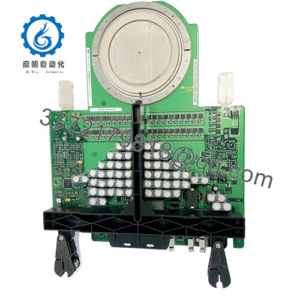
The Honeywell CC-TAIN01 is a 6-inch non-redundant I/O termination assembly for the Experion PKS Series C CC-PAIN01 high-level analog input module. It supports 16 single-ended 4–20 mA channels from 2-wire or self-powered transmitters. The associated CC-PAIN01 provides 16-bit conversion, 50 ms input scanning, 70 dB common-mode rejection, and individually protected transmitter field-power circuits.
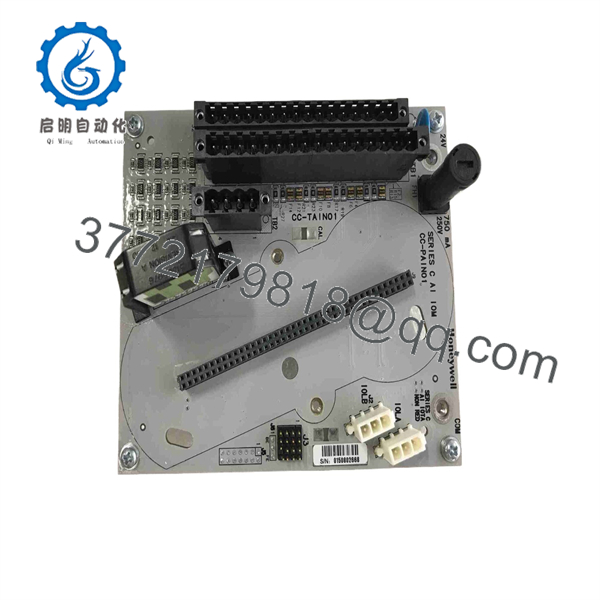
CC-TAIN01
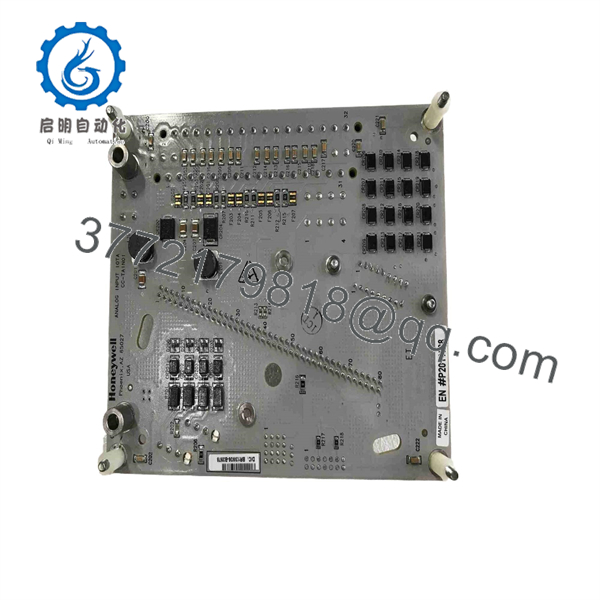
CC-TAIN01
Installation & Configuration Guide
Stage 1 — Pre-Installation
- Confirm that the installed I/O module is CC-PAIN01. CC-TAIN01 is not a generic replacement for every Series C analog-input IOTA.
- Verify that the cabinet architecture requires the 6-inch non-redundant IOTA. For redundant applications, Honeywell specifies CC-TAIN11 instead.
- Record every field-wire termination before removal, including channel number, polarity, transmitter loop, shield, and signal designation.
- Back up the corresponding Experion configuration and document the existing channel assignments.
- Confirm that field instruments use the supported high-level current-input architecture.
- Isolate field power and control power before removing the assembly.
- Apply ESD controls: grounded wrist strap, grounded work surface, and suitable ESD packaging.
- ⚠️ Safety: Do not remove the IOTA while energized unless the approved Honeywell cabinet architecture and site procedures specifically permit the operation.
Typical preparation time: 15–30 minutes, depending on cabinet documentation.
Stage 2 — Removing Old Module
- Place the associated control loop in the approved maintenance state.
- Isolate the applicable 24 VDC/control power and field circuits.
- Verify the absence of hazardous voltage with an appropriate meter.
- Photograph the existing terminal arrangement before disconnecting wiring.
- Label field conductors by channel rather than relying only on wire color.
- Disconnect field wiring without disturbing adjacent I/O circuits.
- Release the IOTA mounting hardware according to the cabinet assembly procedure.
- Remove the old CC-TAIN01 and place it in an ESD-safe container.
⚠️ Critical: The field termination assembly is part of the signal path. A physically similar Series C IOTA does not automatically have the same terminal assignment.
Stage 3 — Installing New Module
- Inspect the replacement CC-TAIN01 for connector damage, corrosion, contamination, or evidence of rework.
- Verify the model marking before installation.
- Seat the IOTA correctly on the Series C mounting arrangement.
- Secure the assembly without over-torquing mounting hardware.
- Reconnect each field conductor against the recorded channel documentation.
- Verify loop polarity and transmitter wiring channel by channel.
- Confirm shield and grounding arrangements against the site wiring standard.
- Do not assume that a different IOTA variant has an interchangeable pinout.
- Recheck every termination before restoring power.
Typical replacement time: 20–45 minutes for a documented cabinet.
Stage 4 — Power-On & Testing
- Perform a final visual and wiring inspection.
- Restore power according to the site’s approved startup sequence.
- Confirm the CC-PAIN01 and associated IOTA are recognized correctly by the Experion system.
- Verify all 16 configured channels.
- Inject or simulate representative 4–20 mA signals where the maintenance procedure permits.
- Confirm engineering-unit scaling at the controller/operator level.
- Check channel diagnostics for unexpected signal, wiring, or field-power alarms.
- Compare actual process values against the pre-maintenance record.
- Return loops to automatic control only after the responsible operator or control engineer approves the results.
- Record the installed model, revision/traceability information, test results, and removed-part disposition.
⚠️ Field warning: A common replacement mistake is treating CC- as the analog-input module itself. CC- is the IOTA/termination assembly; the associated Series C I/O module is CC-. Honeywell explicitly lists them as a matched IOM/IOTA combination.
Frequently Asked Questions (FAQ)
Q1: What is the Honeywell CC-?
CC- is a 6-inch, non-redundant Analog Input IOTA used with the Honeywell Series C CC- high-level analog input module.
Q2: How many analog channels does CC- support?
The associated CC- provides 16 single-ended analog input channels. The specified input is 4–20 mA through 200 Ω.
Q3: Is CC- redundant?
No. Honeywell specifies CC- as the non-redundant 6-inch IOTA. CC-TAIN11 is the 12-inch redundant counterpart for CC-.
Q4: Can CC- be used with CC-PUIO31?
No. Honeywell assigns CC-PUIO31 to the CC-TUIO31 or CC-TUIO41 IOTA family. CC- is associated with CC-.
Q5: Is CC- the same thing as CC-?
No. CC- is the high-level analog input I/O module, while CC- is its associated I/O termination assembly. Replacing one does not replace the other.
Q6: What should be checked before ordering a replacement?
Verify the complete model number, associated I/O module, redundant/non-redundant architecture, cabinet/IOTA size, field-terminal arrangement, and transmitter signal type. Do not select the replacement solely from physical appearance.
Q7: Is a specific commercial part number such as 51306513-175 always interchangeable with CC-?
Supplier listings commonly associate 51306513-175 with CC-, but Honeywell’s cited Series C specification identifies the IOTA by CC- rather than establishing that commercial number in the specification table. For procurement, verify the complete nameplate and revision against the installed assembly before treating a supplier part number as an exact interchange.