WhatsApp: +86 16626708626
 Email:
  Phone: +86 16626708626
Description
3. Key Technical Specifications
| Parameter | Value |
|---|---|
| Manufacturer | Kollmorgen |
| Model | 6SM 71M-3000 |
| Motor Type | Synchronous servo (brushless AC) |
| Rated Speed | 3000 min⁻¹ |
| Standstill Torque (M0) | 22.0 Nm |
| Standstill Current (I0) | 15.6 A |
| Rated Torque (Mn) | 16.3 Nm |
| Rated Current (In) | 12.2 A |
| Rated Power (Pn) | 5.1 kW |
| Peak Current | 51 A |
| Torque Constant | 1.41 Nm/A |
| Voltage Constant | 121 mV·min |
| Supply Voltage | 400 V class |
| Rotor Inertia | 42 kg·cm² |
| Weight (approx.) | 20 kg |
| Feedback (typical) | Resolver (2-pole) |
| Insulation Class | F |
| Thermal Switch | 145 °C ±5 °C |
| Mounting | IM B5 (flange) |
| Protection | Typically IP64/IP65 (confirm on unit) |
Exact options (brake, specific resolver or encoder, shaft variant, connectors) must be verified on the motor nameplate and against the original system requirements.
4. Product Introduction
The Kollmorgen 6SM-71M-3000 is a brushless AC synchronous servo motor from the established 6SM series. It delivers 22 Nm standstill torque and 16.3 Nm rated torque at 3000 rpm, with a rated output of approximately 5.1 kW.
These motors were widely used in machine tools, robotics, packaging, and general industrial automation where good dynamic response and continuous duty capability are required. The 71M frame size offers a practical balance of torque, inertia, and physical size. Most units are equipped with resolver feedback and are designed for operation with matching digital servo amplifiers.
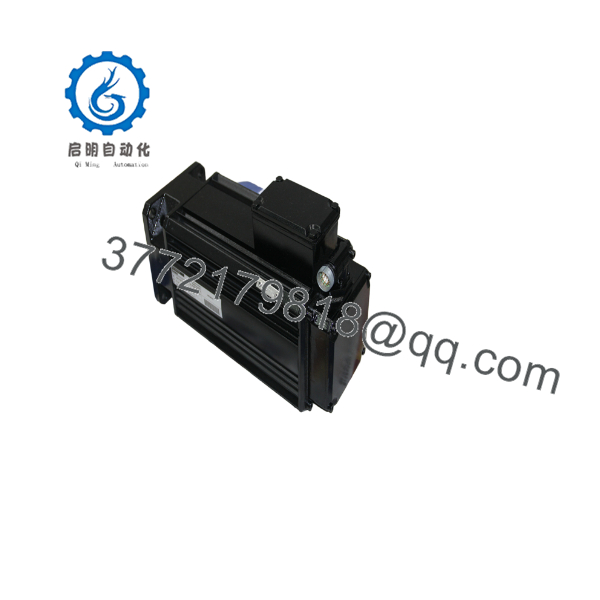
6SM-71M-3000
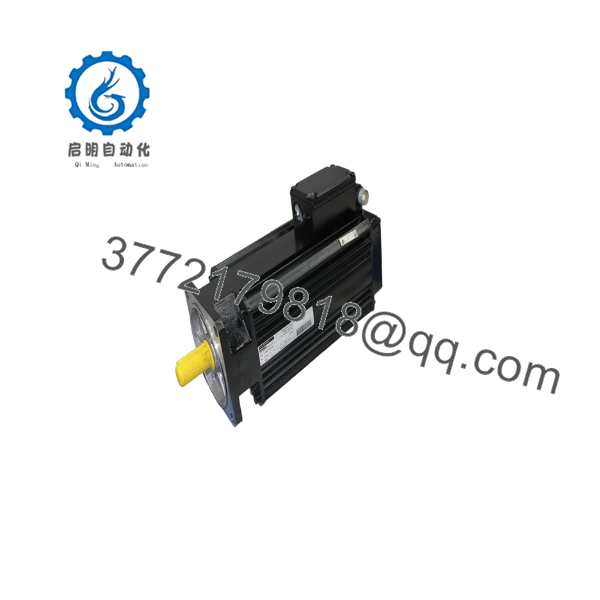
6SM-71M-3000
5. Installation & Configuration Guide
Stage 1: Pre-Installation Preparation (≈15 min) ⚠️ Safety First: Isolate power to the servo drive and motor circuit. Apply lock-out/tag-out. Allow the motor to cool if recently operated. Tools Required: Appropriate lifting equipment (motor is ~20 kg), shaft coupling tools, torque wrench, alignment tools, multimeter. Documentation: Photograph the existing motor nameplate, connector orientation, mounting, and coupling. Note the drive model and any parameter sets.
Stage 2: Removing the Old Motor (≈15–30 min)
- Disconnect power and feedback cables.
- Support the motor and remove mounting bolts.
- Disengage the coupling or belt carefully.
- Inspect the shaft, keyway, and mounting surface. ⚠️ Protect open shaft ends and connectors from contamination.
Stage 3: Installing the New Motor (≈20–40 min)
- Confirm the incoming 6SM-71M-3000 matches the required torque, speed, feedback, and any brake option.
- Clean the mounting flange and shaft.
- Install the coupling or pulley with correct alignment and axial clearance.
- Mount the motor and tighten bolts evenly to the recommended torque.
- Connect power and feedback cables according to the drive manual and motor nameplate. Self-Checklist: [ ] Nameplate matches [ ] Alignment correct [ ] Cables secure and strain-relieved [ ] Rotation direction verified if possible.
Stage 4: Power-On & Testing (≈20–40 min) Pre-Power Check: Verify wiring, grounding, and that the mechanical load is free to move. Power-On Steps:
- Enable the drive at low torque/current limits.
- Perform a phasing or auto-tune procedure if required by the drive.
- Jog the motor in both directions at low speed and check for abnormal noise, vibration, or temperature rise.
- Gradually increase to normal operating parameters and verify positioning accuracy and torque delivery.
- Monitor feedback signals and thermal switch status. ⚠️ Troubleshooting Note: Incorrect feedback wiring or mismatched motor parameters in the drive are the most common causes of faults or poor performance after replacement.
6. Frequently Asked Questions (FAQ)
Q: Is the 6SM-71M-3000 still in current production? The classic 6SM series is a legacy platform. Current Kollmorgen offerings have largely moved to newer families (e.g., AKM, AKMH). Available units are typically new surplus or refurbished.
Q: What feedback does this motor use? Standard configuration uses a 2-pole resolver. Some variants may have different feedback devices—always check the nameplate and connectors on the specific unit.
Q: Can I replace a 6SM 71S or 71K with the 71M? Torque, inertia, and thermal characteristics differ between the K, S, and M lengths. Substitution requires verification of mechanical fit, drive sizing, and application torque requirements.
Q: Does this motor include a holding brake? The base 6SM-71M-3000 designation does not automatically include a brake. Brake versions carry additional suffixes (commonly -G or similar). Confirm on the nameplate.
Q: What drive is compatible? Originally paired with Kollmorgen / Seidel digital servo amplifiers of the corresponding generation. Modern drives can often run the motor if motor data (Kt, Ke, resistance, inductance, inertia, pole count) are correctly entered and feedback is supported.
Q: Why is the price lower than a new AKM-series motor? This is a legacy model sold on the secondary market. Pricing reflects condition, testing, residual demand, and the fact that it is no longer a current-production catalog item.
Q: What should I verify before installation? Match the full model string, feedback type, shaft details, and any brake option. Confirm the servo drive is parameterized correctly for the motor data and that mechanical alignment is within tolerance.