WhatsApp: +86 16626708626
 Email:
  Phone: +86 16626708626
Description
Key Technical Specifications
| Parameter | Specification |
| Motor Type | 2-Phase Hybrid Stepper Motor |
| Frame Size | NEMA 34 (86 mm x 86 mm flange) |
| Rotor Stack Length | 2-Stack Length (H32 designator) |
| Step Angle | 1.8° (200 full steps per revolution) |
| Winding Type | High-efficiency copper winding (customizable drive current matching) |
| Shaft Configuration | Single round / keyed shaft extension (Standard “N” shaft) |
| Holding Torque Range | High dynamic torque output (typical range 3–5 N·m depending on drive current) |
| Feedback / Option Code | Non-encoder (“NS”) / No holding brake |
| Insulation Class | Class B / Class F (130^\circC to 155^\circC maximum temperature rise) |
| Enclosure Rating | IP40 / IP65 (depending on shaft seal integration) |
Product Introduction & Application Context
The Kollmorgen H32NCHA-LNN-NS-00 is a rugged, heavy-duty NEMA 34 hybrid stepper motor engineered for industrial applications requiring reliable open-loop position control without the cost or complexity of traditional closed-loop servo networks. Deployed extensively across CNC routing tables, automated labeling machinery, semiconductor indexing drives, and medical positioning equipment, the H-series delivers high holding torque at low speeds and low magnetic cogging.
Sourcing a genuine Kollmorgen H32 replacement unit guarantees exact mechanical bolt-pattern registration and matching electrical inductance parameters. Substituting mismatched stepper motors can lead to resonant mid-band instability, lost steps during rapid acceleration, or excessive thermal heating in the stepper drive power stage.
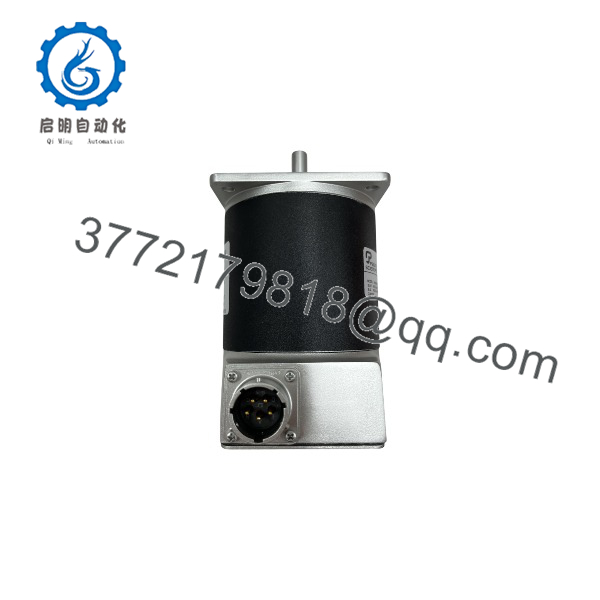
H32NCHA-LNN-NS-00
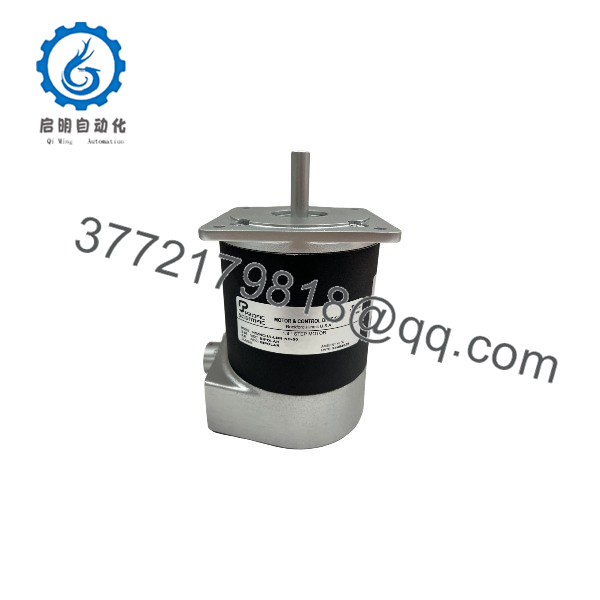
H32NCHA-LNN-NS-00
Installation & Configuration Guide
1.Pre-Installation Isolation:Disconnect drive power and observe mechanical safety.
Disconnect DC bus or AC mains power to the stepper drive amplifier. Apply Lock-Out/Tag-Out (LOTO) procedures and verify zero electrical energy in motor output terminals.
2.Mechanical Disassembly:Unbolt shaft coupling and remove legacy motor.
Loosen the flexible shaft coupling or drive pulley attached to the motor shaft. Unbolt the NEMA 34 mounting flange bolts and ease the old motor out of the mounting bracket.
3.Physical Mounting & Coupling:Align shaft keyway and mount new stepper motor.
Clean the mounting bracket face. Align the new H32NCHA-LNN-NS-00 motor flange and slide the shaft into the coupling without applying axial force to the front bearing. Tighten mounting bolts to standard torque specifications.
4.Wiring & Drive Setup:Wire phase leads and configure drive peak current.
Connect phase leads (A, A-, B, B-) to the stepper drive according to the motor wiring diagram. Verify drive peak current settings (I_{peak}) match the motor’s rated current to prevent thermal overload. Reapply power and run slow jog motion tests.
Motor Nomenclature & Part Number Breakdown
- H: Kollmorgen High-Torque Hybrid Stepper Series
- 32: NEMA 34 Frame Size, 2 Rotor Stack Length
- N: Standard NEMA Shaft/Flange Mounting Dimensions
- C: Specific Winding Code (determines phase current, resistance, and inductance)
- H: Heavy-duty construction designator
- A-LNN: Lead wire connection / standard housing options
- NS: No Shaft Rear Extension / No Optical Encoder
- 00: Standard Factory Modification Code
Frequently Asked Questions (FAQ)
Q: What does “NEMA 34” mean for the H32NCHA motor?
A: NEMA 34 specifies the standardized motor faceplate dimensions: a 3.4\times 3.4 inch (86\times 86 mm) square mounting flange with standard pilot diameter and hole spacing.
Q: Can I drive this motor with a modern microstepping drive?
A: Yes. The H32NCHA-LNN-NS-00 works seamlessly with standard bipolar chopper drives, supporting microstepping resolution up to 50,000 steps/rev for quiet, resonance-free movement.
Q: Does this model include an integrated encoder or holding brake?
A: No. The “NS” designation indicates a standard single-shaft motor without an optical encoder or integral electromagnetic holding brake.
Q: What causes lost steps or stall conditions in this stepper motor?
A: Lost steps typically result from excessive acceleration rates, running the motor beyond its speed-versus-torque curve limits, insufficient drive current setting, or mechanical binding in the driven linear axis.