WhatsApp: +86 16626708626
 Email:
 Phone: +86 16626708626
Description
Core Product Summary
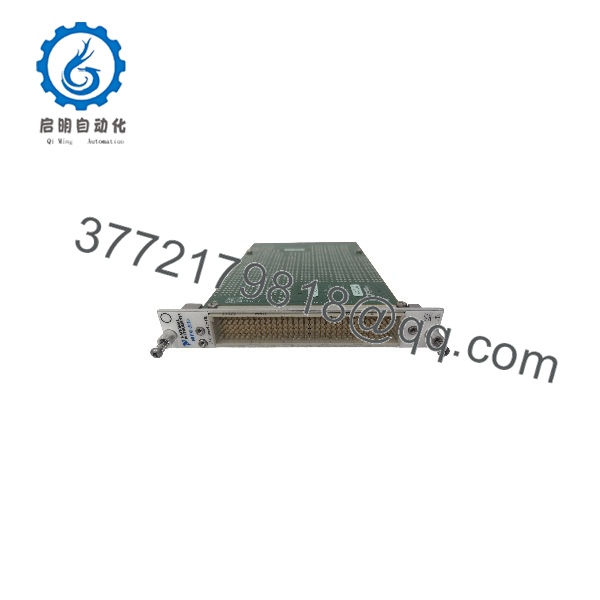
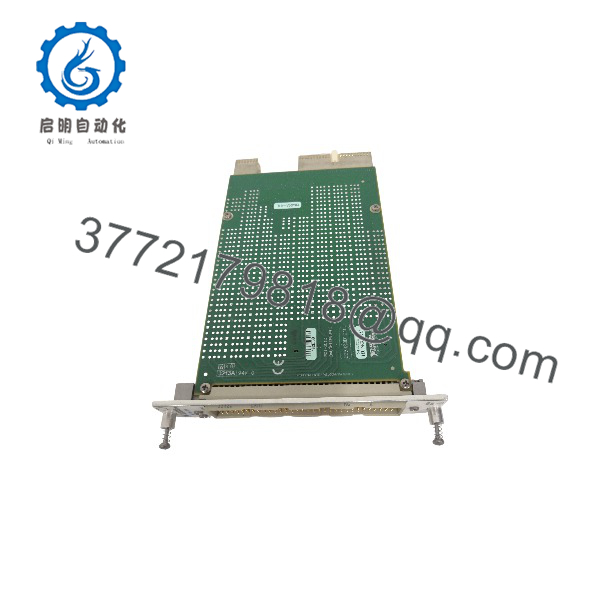
The National Instruments PXI-2510 is a 68-channel, 2 A PXI signal insertion switch module (fault insertion unit). It is designed for hardware-in-the-loop (HIL) testing and electronic reliability validation.
Each channel can be opened or shorted to one or more fault buses, enabling simulation of open circuits, pin-to-pin shorts, shorts to battery voltage, and shorts to ground. When used with LabVIEW Real-Time, it is suitable for validating control systems such as engine control units (ECUs) and full authority digital engine controls (FADECs).
Key Technical Specifications
| Parameter | Value |
|---|---|
| Product type | PXI signal insertion switch / fault insertion unit (FIU) |
| Number of channels | 68 |
| Maximum switching current (DC) | 2 A |
| Maximum switching voltage (DC) | 150 V |
| Relay type | Electromechanical |
| Switch bandwidth | 6.5 MHz (typical, 50 Ω system) |
| Bus connector | PXI Hybrid |
| Form factor | 3U, one-slot PXI module |
| Part number | 778572-10 |
| Operating temperature | 0 °C to 55 °C |
| Weight | 358 g (12.6 oz) |
Detailed Product Overview
The PXI-2510 is a fault insertion unit (FIU) that inserts controlled faults into signal paths between a test system and a device under test. It provides 68 independent feedthrough channels. In the normal (closed) state the channels pass signals transparently. Under software control any channel can be opened to simulate an open or interrupted connection, or shorted to one of two fault buses to simulate shorts between pins, shorts to battery voltage, or shorts to ground.
The module uses electromechanical relays rated for 150 V and 2 A. Typical bandwidth exceeds 6.5 MHz, making it compatible with many automotive communication signals such as CAN and FlexRay. Relay operate time is typically 1 ms (maximum 3 ms). Expected mechanical life is 1 × 10⁸ cycles.
The PXI-2510 occupies a single 3U PXI slot and uses a PXI Hybrid connector. Front-panel connection is via a 160-pin DIN 41612 male connector. It is intended for indoor use in Measurement Category I environments with signal voltages not exceeding 150 V.
When controlled by the LabVIEW Real-Time Module, the module supports deterministic fault insertion required for rigorous HIL validation of safety-critical control systems.
PXI-2510
PXI-2510
System Compatibility & Integration Requirements
| Item / Dependency | Verified Compatibility or Requirement | Practical Note |
|---|---|---|
| Platform | PXI / PXI Hybrid chassis | Single 3U slot |
| Software | LabVIEW, LabVIEW Real-Time Module | Deterministic HIL control |
| Channels | 68 feedthrough channels | Independent open/short to fault buses |
| Switching rating | 150 V DC, 2 A | Electromechanical relays |
| Bandwidth | >6.5 MHz typical | Suitable for many serial communication signals |
| Front-panel connector | 160-pin DIN 41612 male | Requires compatible cable/terminal block |
| Application | Hardware-in-the-loop (HIL), reliability testing | ECU, FADEC, and similar control system validation |
Dimensions, Mounting & Connection Notes
- Form factor: 3U, one-slot PXI module
- Dimensions (L × W × H): 18.8 cm × 2.0 cm × 13.0 cm (7.4 in × 0.8 in × 5.1 in)
- Weight: 358 g
- Operating temperature: 0 °C to 55 °C
- Storage temperature: –40 °C to 70 °C
- Front connector: 160-pin DIN 41612 male
FAQ
What is the NI PXI-2510?
It is a 68-channel, 2 A PXI fault insertion unit (signal insertion switch module) used for hardware-in-the-loop testing and electronic reliability validation.
How many channels does it provide?
The module provides 68 independent feedthrough channels.
What faults can it simulate?
It can simulate open/interrupted connections, pin-to-pin shorts, shorts to battery voltage, and shorts to ground on a per-channel basis.
What are the voltage and current ratings?
Maximum switching voltage is 150 V DC and maximum switching current is 2 A per channel.
Which software is recommended?
LabVIEW with the LabVIEW Real-Time Module is recommended for deterministic control in HIL applications.