WhatsApp: +86 16626708626
 Email:
  Phone: +86 16626708626
Description
Key Technical Specifications
| Parameter | Specification |
|---|---|
| Manufacturer | R. STAHL |
| Product Family | IS1 Remote I/O |
| Series | 9470/22 |
| Full Model | 9470/22-16-11 |
| Order Number | 168682 |
| Module Type | Digital Input Module, NAMUR |
| Number of Channels | 16 |
| Input Technology | Ex i / intrinsically safe |
| Field Devices | NAMUR proximity switches, volt-free contacts |
| Input Standard | EN 60947-5-6 |
| Maximum Frequency | 20 kHz on channels 14 and 15 |
| Input Safety | Ex ia IIC |
| Line Monitoring | Open-circuit and short-circuit monitoring |
| Isolation | Galvanic isolation between inputs and system |
| Maximum Power Consumption | 5 W |
| Maximum Power Dissipation | 5 W |
| Ambient Temperature | −20 to +65 °C |
| Module Protection | IP30 |
| Connection Protection | IP20 |
| Weight | Approx. 316 g |
| Field Connection | 16-pole plug-in terminal, up to 2.5 mm² / 14 AWG |
The current R. STAHL datasheet specifies 16 channels, Ex ia IIC inputs, line-fault monitoring, a −20 to +65 °C ambient range, 316 g weight, and 11.6 V / 22 mA / 51 mW maximum intrinsic-safety output parameters.
The technical documentation also specifies 5 W maximum power consumption, IP30 module protection, IP20 connection protection, and 16-pole plug-in terminals.
Product Introduction
The R. STAHL 9470/22-16-11 is a 16-channel NAMUR digital input module for the IS1 Remote I/O system. It interfaces intrinsically safe field devices such as NAMUR proximity switches and dry contacts while providing individual monitoring for open circuits and short circuits. The inputs are designed for hazardous-area applications with Ex i protection.
Channels 14 and 15 can additionally perform frequency measurement or pulse counting up to 20 kHz, making the module useful where discrete detection and pulse-related signals share the same remote I/O architecture. The module also uses a redundant interface to the IS1 BusRail.
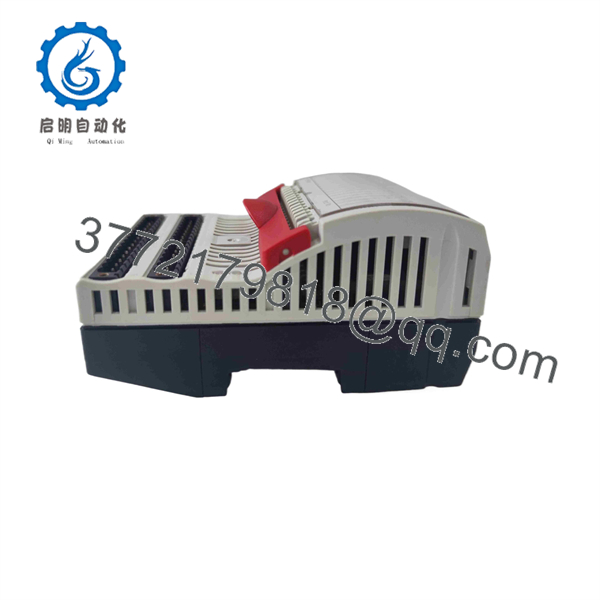
947022-16-11
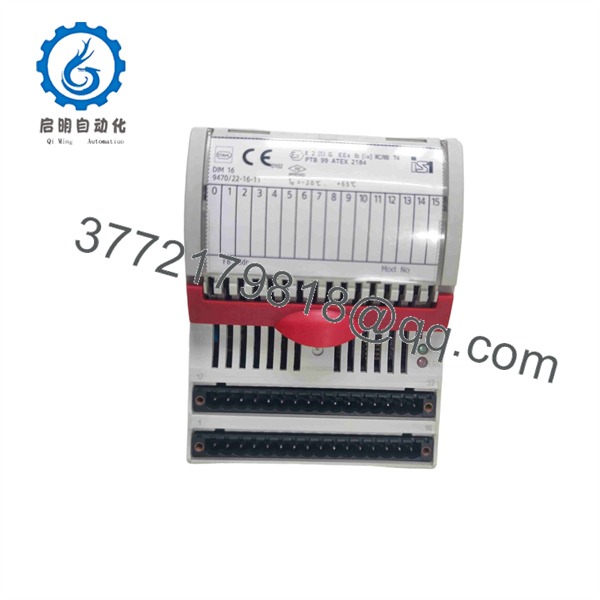
947022-16-11
Installation & Configuration Guide
Stage 1 — Pre-Installation
Estimated time: 30–45 minutes
- ⚠️ Place the affected process equipment in a safe state and follow the site’s approved LOTO procedure.
- Confirm that the replacement nameplate reads 9470/22-16-11 and, where applicable, order number 168682.
- Verify that the installed I/O architecture uses the compatible R. STAHL IS1 BusRail.
- Record the existing channel assignment, NAMUR devices, diagnostic settings, and PLC/DCS I/O mapping.
- Back up the applicable controller and remote-I/O configuration.
- Confirm the hazardous-area classification and enclosure requirements before replacement.
Important: This is not a generic 24 V digital input card. Its input circuitry and hazardous-area certification are part of the IS1 system architecture.
Stage 2 — Remove the Existing Module
- Confirm that the replacement procedure is authorized for the installed hazardous-area system.
- Document the existing module’s position and orientation.
- Record field wiring and channel assignments.
- Disconnect the field-side terminal assembly according to the applicable STAHL procedure.
- Remove the module from the BusRail using the specified mechanical release mechanism.
- Inspect the BusRail contacts and adjacent modules for contamination or mechanical damage.
Stage 3 — Install the 9470/22-16-11
Estimated time: 20–40 minutes
- ⚠️ Verify the exact 9470/22-16-11 variant before installation.
- Check the replacement housing, connector, identification label, and mechanical interface.
- Install the module into the correct IS1 BusRail position.
- Reconnect the field terminal assembly without changing the established channel allocation.
- Verify NAMUR proximity-switch wiring and any required line-fault monitoring components.
- If channels 14 and 15 are used for frequency measurement, verify the configured measurement range and counter function.
- Confirm that the module configuration in the host system corresponds to the installed module type.
Stage 4 — Power-On and Testing
Estimated time: 30–60 minutes
- Perform a complete wiring and mechanical inspection before energization.
- ⚠️ Verify that all hazardous-area work is complete before restoring power.
- Power the IS1 system according to the approved site procedure.
- Check module status and diagnostic indications.
- Verify communication between the module and the IS1 host/CPU interface.
- Test representative digital inputs from the field device side.
- Verify open-circuit and short-circuit diagnostics where those functions are configured.
- For channels 14 and 15, perform a controlled frequency/pulse test if those functions are used.
- Confirm correct input states at the PLC/DCS application layer.
- Record the module serial number, configuration, test results, and replacement date.
R. STAHL documentation explicitly states that the module can be replaced during operation in the appropriate IS1 architecture, but site hazardous-area procedures and the exact installed system configuration still govern whether a particular replacement can be performed live.
FAQ
What is the R. STAHL 9470/22-16-11 used for?
It is a 16-channel NAMUR digital input module for the R. STAHL IS1 Remote I/O system. It accepts NAMUR proximity switches and volt-free contacts in intrinsically safe applications.
Is 947022-16-11 the same part as 9470/22-16-11?
Yes. 947022-16-11 is a common condensed representation of 9470/22-16-11. R. STAHL documentation identifies the formal type as 9470/22-16-11 and order number 168682.
How many inputs does it have?
The module has 16 digital input channels. Channels 14 and 15 have the additional capability of frequency measurement or pulse counting up to 20 kHz.
Can it monitor wiring faults?
Yes. Each field circuit can be monitored for open circuit and short circuit. For installations requiring line-fault monitoring, the field wiring must use the appropriate resistor arrangement specified by the STAHL documentation.
Is the 9470/22-16-11 intrinsically safe?
Yes. It is designed with Ex ia IIC intrinsically safe inputs for appropriate hazardous-area applications. The current STAHL documentation lists application in Zones 1, 2, 21, and 22, subject to the applicable installation requirements.
Can it be hot-swapped?
The STAHL documentation states that the module can be replaced during operation within the IS1 system. However, that does not mean every installation should be serviced live. Hazardous-area classification, permit requirements, system architecture, and the site’s electrical safety procedures must be checked first.
What should I verify when purchasing a replacement?
Verify the complete designation 9470/22-16-11, order number 168682, connector/terminal configuration, hardware revision, and physical condition. Current market listings include used, refurbished, and open-box units, so the seller’s stated condition should not be assumed to represent factory-new condition.