WhatsApp: +86 16626708626
 Email:
  Phone: +86 16626708626
Description
Key Technical Specifications
| Parameter | Specification |
|---|---|
| Manufacturer | Triconex / Schneider Electric |
| Model | 8120E |
| Product Type | Enhanced Performance Main Chassis |
| System | Tricon Safety Instrumented System |
| Architecture | Triple Modular Redundancy (TMR) |
| Processor Support | Up to 3 Main Processor Modules |
| Processor Family | 3008 / 3009, depending on Tricon system revision |
| Backplane Architecture | TriBus |
| TriBus Speed with 3009 | Up to 1,000 Mbps |
| Installation | Main rack / chassis |
| Application | Safety and critical process control |
| Typical System | Tricon v9.6 and later references |
| Housing | Rack/chassis assembly |
| Approx. Shipping Weight | 25 kg reported by one distributor |
| Country of Origin | USA reported by secondary-market listings |
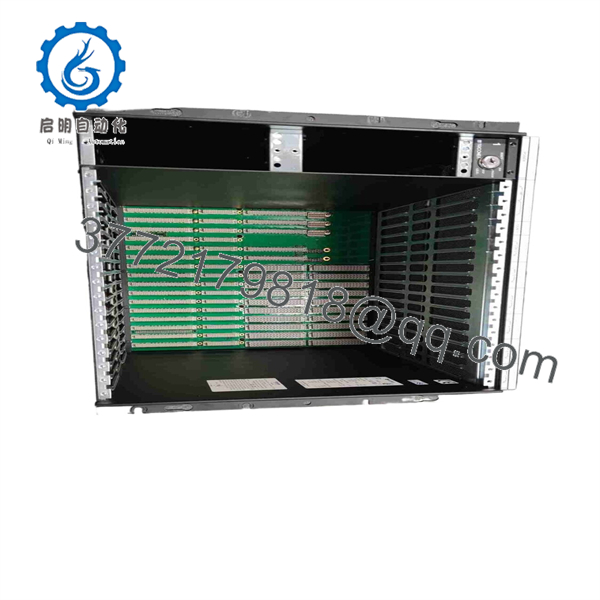
The Triconex 8120E is an Enhanced Performance Main Chassis for the Tricon safety controller platform. Its primary job is physical and electrical: it provides the chassis/backplane infrastructure for the redundant Main Processor Modules and associated I/O and communication hardware. Current technical listings identify the 8120E with Tricon systems using Model 3008 processors, while Model 3009 documentation identifies the 8120E as supporting a 1,000 Mbps TriBus connection.
Because the 8120E is a chassis rather than an independent controller, specifications such as processor capacity, I/O configuration, power arrangement, and communication performance depend on the modules installed in the chassis. Do not treat generic distributor specifications as a substitute for the applicable Tricon system hardware manual.
Product Introduction
The Triconex 8120E is an Enhanced Performance Main Chassis used as the central rack assembly of a Tricon Safety Instrumented System. It provides the physical mounting and backplane infrastructure for redundant Main Processor Modules and I/O modules, supporting the Tricon platform’s TMR architecture.
The chassis is particularly relevant when maintaining legacy Tricon installations where processor generation and system revision must be matched carefully. Model 3008 processors are documented for Tricon v9.6 and later systems, while Model 3009 documentation identifies the 8120E as the high-speed chassis with a 1,000 Mbps TriBus interface.
Installation & Configuration Guide
Stage 1 — Pre-Installation Preparation
Estimated time: 30–60 minutes
- Notify operations and the safety-system owner before starting maintenance.
- Place the affected SIS in the plant-approved maintenance/bypass state.
- Follow the site’s LOTO and functional-safety maintenance procedure.
- Confirm that any required process protection or shutdown coverage has been formally addressed before removing the chassis.
- Allow at least 5 minutes after power isolation for stored electrical energy to discharge.
- Wear an ESD wrist strap and use an antistatic work surface.
- Prepare:
- PH1 screwdriver
- Digital multimeter
- Wire/module labels
- Camera or phone
- Tricon system hardware documentation
- Approved configuration backup
- Record the installed chassis model, processor models, chassis arrangement, and system revision.
- Photograph module positions and all external connections.
⚠️ Critical: This is SIS infrastructure, not a normal PLC rack. Do not remove an 8120E from a live safety system unless the approved Tricon maintenance procedure explicitly permits the operation.
8120E
Stage 2 — Removing the Old Module
Estimated time: 30–60 minutes
- Confirm the SIS has been placed in its approved maintenance condition.
- Verify all applicable power sources are isolated.
- Label external cables and power connections.
- Record the exact position of each processor and I/O module.
- Remove installed modules using the approved Tricon service procedure.
- Protect removed modules against ESD and contamination.
- Remove chassis mounting hardware.
- Carefully withdraw the 8120E chassis from the cabinet.
- Inspect:
- Backplane connectors
- Module guides
- Grounding points
- Power connections
- Rack mounting hardware
- Signs of corrosion or overheating
- Retain the old chassis until the replacement system has completed its validation.
⚠️ Do not interchange processor positions casually. The physical chassis may be passive infrastructure, but the installed processor and I/O arrangement determines the functional system configuration.
Stage 3 — Installing the New Module
Estimated time: 45–75 minutes
- Confirm the replacement chassis is marked 8120E.
- Compare the replacement chassis with the original before installation.
- Verify connector and mounting compatibility.
- Inspect the backplane for bent, contaminated, or damaged contacts.
- Mount the chassis securely in the approved cabinet location.
- Verify protective grounding.
- Reconnect power and external interfaces according to the approved drawings.
- Reinstall the Main Processor Modules in their documented positions.
- Reinstall I/O and communication modules in their documented positions.
- Verify all mechanical latches and module retainers.
- Confirm the processor and I/O configuration against the saved system configuration.
- Perform a point-to-point inspection before applying power.
⚠️ Do not assume that a physically compatible processor is automatically system-compatible. Model 3008 and 3009 processors have different system-generation characteristics, including TriBus performance. Verify the exact Tricon software and hardware revision before commissioning.
Stage 4 — Power-On & Testing
Estimated time: 60–120 minutes
- Confirm the chassis wiring and grounding.
- Check for unintended shorts on the applicable supply rails.
- Energize the chassis according to the approved Tricon startup procedure.
- Check processor and chassis status indications.
- Confirm all three processor paths establish the expected redundant communication state.
- Verify I/O communication and module diagnostics.
- Check system diagnostic information through the approved Tricon engineering environment.
- Confirm that no unexpected chassis, processor, I/O, or communication faults are reported.
- Verify the loaded configuration against the approved baseline.
- Perform the required online diagnostic and proof-test activities.
- Confirm safety-system voting and shutdown logic through the plant’s approved validation procedure.
- Document final chassis identification, processor arrangement, diagnostic status, and test results.
⚠️ Do not return an SIS to service merely because all chassis LEDs are normal. The acceptance criterion is the complete safety-system validation, including processor redundancy, I/O communication, diagnostics, configuration integrity, and the plant-approved functional test.
For replacement QC, retain incoming inspection records, chassis identification photographs, backplane inspection results, processor/module configuration records, power checks, diagnostic screenshots, and final validation evidence.
Frequently Asked Questions (FAQ)
1. What is the Triconex 8120E?
The 8120E is an Enhanced Performance Main Chassis for the Tricon Safety Instrumented System. It provides the rack and backplane infrastructure required for redundant Tricon processors and associated modules.
2. How many Main Processor Modules can the 8120E accommodate?
Available product documentation identifies the 8120E as a chassis designed to accommodate three Main Processor Modules, consistent with the Tricon TMR architecture.
3. Which processors are compatible with the 8120E?
Model 3008 Main Processors are documented for Tricon v9.6 and later systems. Model 3009 documentation also specifically identifies the 8120E as an Enhanced Performance Main Chassis and reports a 1,000 Mbps TriBus interface when paired with the 3009. Compatibility must therefore be checked against the complete Tricon system revision rather than the chassis model alone.
4. Is the 8120E a standalone controller?
No. The 8120E is a main chassis/rack assembly, not a standalone programmable controller. The processor, I/O, communication, and power modules installed in the chassis provide the system’s active control functions.
5. Is 8120E suitable for TMR safety applications?
Yes. The chassis is part of the Tricon platform, which uses Triple Modular Redundancy (TMR). The exact safety certification and SIL capability apply to the complete certified system configuration, not simply to the empty chassis. Do not claim a standalone chassis certification independently of the system configuration.
6. Can an 8120E replace an older Tricon chassis directly?
Not necessarily. Before replacement, verify the Tricon system version, processor generation, I/O modules, power arrangement, communication hardware, cabinet dimensions, and configuration/software revision. A chassis replacement should be treated as an SIS maintenance activity rather than a generic rack swap.
7. What condition is available for the 8120E?
Secondary-market listings currently show used/refurbished, new surplus, and sealed-surplus descriptions depending on supplier. One current listing shows used units as tested functional, while other listings advertise refurbished or unused stock. Confirm the actual chassis condition, backplane inspection, serial number, and warranty before purchase.