WhatsApp: +86 16626708626
 Email:
  Phone: +86 16626708626
Description
Key Technical Specifications
| Parameter | Value |
|---|---|
| Model | Triconex 8312 |
| Product family | Tricon v9–v10 safety-system platform |
| Product type | Redundant chassis power module |
| Nominal input voltage | 230 VAC |
| Permitted AC input range | 185–285 VAC |
| Input frequency | 47–63 Hz |
| DC input option | Not applicable |
| Required incoming supply capacity | Minimum 240 W per installed power module |
| Input fuse | 2.5 A, time-delay |
| Inrush current | 18 A maximum for one-half AC cycle |
| Power factor | 0.70 |
| Logic output voltage | 6.5 VDC ±1% |
| Minimum output current | 27 A at 60 °C ambient |
| Rated power output | 175 W at 60 °C ambient |
| Output hold-up time | 20 ms minimum |
| Overvoltage protection | 125% typical |
| Overcurrent protection | 140% typical |
| Operating ambient temperature | 0 to +60 °C |
| Relative humidity | 5% to 95%, non-condensing |
| Chassis compatibility | Tricon 8110 main, 8111 expansion, and 8112 RXM chassis |
| Redundancy arrangement | Two power modules per Tricon chassis |
| Online replacement | Supported when the companion power module is healthy |
| Approximate module weight | 7.2 lb / 3.3 kg |
| Alarm indications | PASS, FAIL, TEMP, and BAT LOW indicators |
| Hazardous-area restriction | Not suitable for ATEX-required Tricon systems |
| Product status | Legacy / limited aftermarket availability |
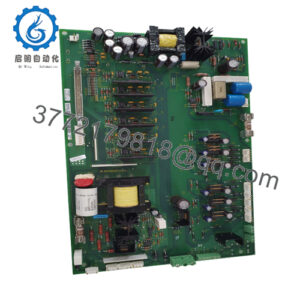
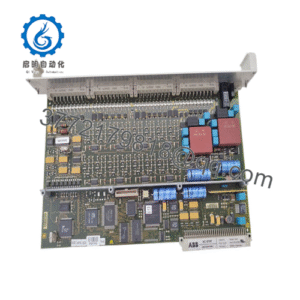
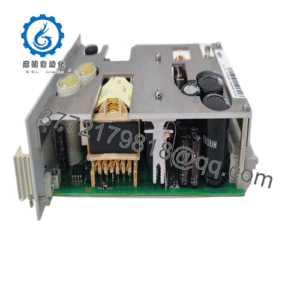
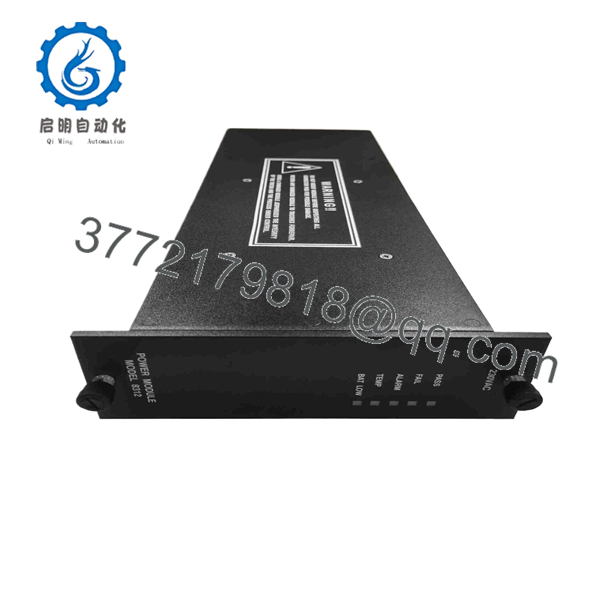
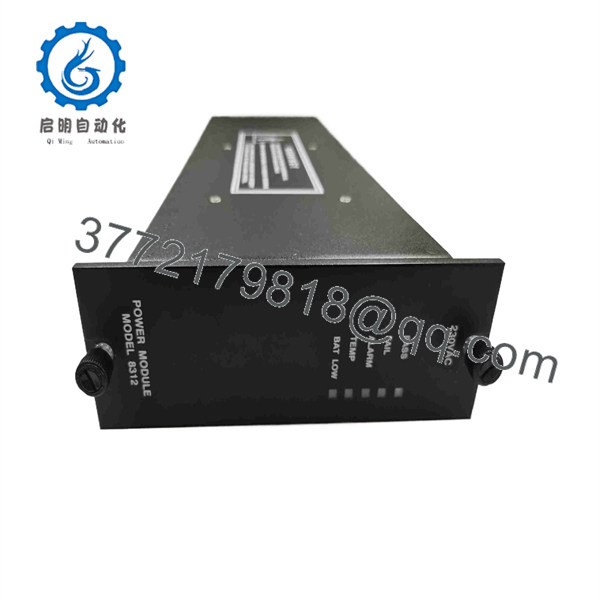
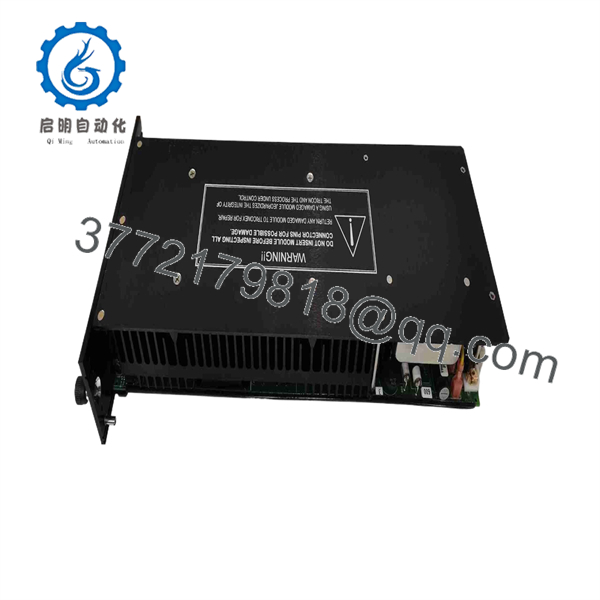
The Triconex 8312 is the 230 VAC power module for Tricon main, expansion, and RXM chassis. Each chassis uses two power modules, and either healthy module can support full chassis load at rated temperature. The module converts incoming AC line power into regulated 6.5 VDC logic power for the Tricon system.
Product Introduction
The Triconex 8312 is a 230 VAC power module for Tricon v9–v10 safety-system chassis. It supplies regulated logic power to main processors, I/O modules, communication modules, and chassis backplane circuits in 8110 main, 8111 expansion, and 8112 RXM chassis.
Each Tricon chassis uses two redundant power modules. A single healthy 8312 can carry full chassis load at rated temperature, allowing online replacement of the failed companion module under an approved SIS maintenance procedure. Do not use the 8312 where the Tricon installation must meet ATEX requirements; use the approved 24 VDC power architecture instead.
8312
8312
8312
Troubleshooting Quick Reference
| Symptom | Possible Cause | Relevance to this Part | Quick Check Method | Recommendation |
|---|---|---|---|---|
| 8312 PASS indicator is off | Missing AC input, open fuse, failed power module, loose chassis seating | ✅ High | Measure incoming voltage at the chassis power terminal under safe conditions. Confirm 185–285 VAC at 47–63 Hz and inspect the module seating and 2.5 A time-delay fuse. | Check external supply and fuse first. Replace the module if valid AC input is present and the module remains nonfunctional. |
| Both chassis power modules show fault | Common 230 VAC feed loss, upstream breaker trip, shared terminal fault, chassis backplane problem | ⚠️ Medium | Measure AC input to both power-module feeds. Check upstream disconnects, breakers, terminal tightness, and common supply wiring. | Investigate common power distribution first. Simultaneous faults rarely prove that both 8312 modules failed. |
| One module FAIL indicator is on, but chassis remains online | One power module fault, one input feed loss, module internal failure, bad seating | ✅ High | Confirm that the other power module shows normal operation and is carrying the chassis. Measure the affected module’s 230 VAC input and inspect its seating. | Replace the failed 8312 through the approved online-replacement procedure only after confirming the redundant module is healthy. |
| TEMP indicator is active | High cabinet temperature, blocked ventilation, overload, failed cooling fan, power module degradation | ⚠️ Medium | Measure cabinet air temperature near the chassis and inspect filters, fans, and airflow. Confirm ambient remains within 0 to +60 °C. | Correct cabinet cooling first. If temperature remains acceptable and TEMP persists, schedule module replacement. |
| BAT LOW indicator is active | Internal backup battery depleted, module aging, long service interval | ✅ High | Record all front-panel LED states and Tricon diagnostics. Confirm the alert belongs to the specific power module, not a controller or external UPS. | Plan replacement during the next approved maintenance window. Do not ignore a BAT LOW warning in a safety-system chassis. |
| Chassis reports configuration or module alarms | Missing I/O module, hardware-to-application mismatch, module failure, main processor system fault | ❌ Low | Review TriStation diagnostics and compare installed hardware with the released system configuration. Verify all modules are fully seated. | The 8312 alarm contacts can report chassis/system faults, but the root cause may be an I/O module, processor, or configuration discrepancy. |
| Logic voltage instability or system resets | Weak power module, overloaded chassis, loose backplane contact, input brownout | ⚠️ Medium | Check AC input while the system is loaded. Review chassis loading and inspect the module connector and retention hardware under approved outage conditions. | Verify incoming supply capacity is at least 240 W per power module. Replace the module only after ruling out source undervoltage and chassis overload. |
| Replacement module powers up but alarms remain | Wrong module type, wrong input voltage, configuration issue, second power module fault | ⚠️ Medium | Confirm the replacement is 8312, not 8310 or 8311. Verify the cabinet has 230 VAC service and compare all active alarms before and after replacement. | Do not substitute an 8312 into a 24 VDC or 120 VAC/VDC application. Match the power-module model to the available supply and approved system design. |
| System fault occurs during online power-module replacement | Companion module not healthy, replacement not fully seated, input feed unavailable, procedure error | ✅ High | Before removal, verify the companion power module is PASS, free of TEMP/BAT LOW warnings, and connected to a valid supply. Follow the site’s approved online-maintenance sequence. | Stop if redundancy is not healthy. Do not turn a single fault into a full chassis shutdown by pulling the wrong module or working without validated redundancy. |
| Multiple chassis report loss of power | Shared UPS failure, upstream breaker trip, switchgear issue, cabinet distribution failure | ❌ Low | Check whether adjacent Tricon chassis and unrelated control loads lost power at the same time. Review upstream protective-device status. | Start at the common power source. A multi-chassis event is not normally caused by one 8312 module. |
❗ ATEX restriction: Do not use the 8312 in a Tricon system that must meet ATEX hazardous-location requirements. For a 230 VAC plant supply in that application, the documented approach is an 8311 24 VDC power module fed by an ATEX-certified 24 VDC supply, such as the specified Phoenix Contact architecture. Verify the current approved system documentation before making any change.
❗ Redundancy warning: The 8312 can be replaced online only when the companion power module is healthy and its input source is proven available. Check PASS, FAIL, TEMP, and BAT LOW indicators before removal. Do not perform a casual “live swap” in a safety system.
❗ Input-voltage warning: The 8312 is a 230 VAC module with an operating input range of 185–285 VAC. It is not a 24 VDC module and not a universal DC supply. Verify actual terminal voltage and system grounding before insertion.
❗ ESD and safety warning: Wear a grounded wrist strap, use the prescribed SIS maintenance procedure, and do not touch backplane power contacts. Preserve TriStation diagnostics before replacing hardware. If the chassis supports active shutdown or emergency-control functions, coordinate the work with operations and the responsible safety engineer.
Keep these checks in mind and you will save yourself 90% of typical rework time. If the fault remains unresolved, provide technical support with clear front-panel LED photos, power-module serial labels, AC voltage readings, chassis type, module inventory, TriStation diagnostic export, cabinet ambient temperature, and the maintenance action that preceded the alarm.
Frequently Asked Questions (FAQ)
Q: What does the Triconex 8312 do?
A: The 8312 converts 230 VAC line power into regulated low-voltage logic power for a Tricon chassis. It supports Tricon v9–v10 main, expansion, and RXM chassis and supplies 6.5 VDC logic power at up to 27 A, or 175 W, at 60 °C ambient.
Q: Is the 8312 a 230 VAC or 24 VDC power module?
A: The 8312 is the 230 VAC Tricon power module. Its permitted input range is 185–285 VAC at 47–63 Hz. The 8311 is the 24 VDC power-module variant; do not interchange them without confirming the chassis supply architecture and the approved system design.
Q: Can one 8312 run the entire Tricon chassis?
A: Yes. Each Tricon chassis has two power-module positions, and either healthy module is designed to support the chassis at full load and rated temperature. The second module provides redundancy. Confirm that the remaining module is healthy before removing the failed one.
Q: Can I hot-swap a Triconex 8312?
A: The module supports online replacement when the companion power module is healthy and the site’s SIS procedure authorizes it. That does not mean every condition is safe for a live change. Check the redundant module status, input feed, chassis diagnostics, bypass requirements, and approved maintenance plan before touching the unit.
Q: What does the BAT LOW indicator mean?
A: BAT LOW indicates a low internal battery condition in the power module. Record the warning and arrange a controlled replacement. In a safety application, do not leave a battery warning unaddressed just because the other power module currently carries the chassis.
Q: Why is the 8312 rated at 175 W while the incoming supply should be 240 W?
A: The 175 W figure is the module’s rated output capability at 60 °C. The recommended incoming supply capacity of at least 240 W per power module accounts for conversion losses, inrush, operating margin, and reliable system behavior under load. Size the upstream circuit to the documented requirement rather than the output wattage alone.
Q: Can I use the 8312 in an ATEX hazardous-area Tricon installation?
A: No. The available Tricon documentation explicitly warns against using the 8312 in systems that must meet ATEX requirements. Use the approved 24 VDC 8311 power-module arrangement with an ATEX-certified DC power supply instead. Confirm the final design with the site’s hazardous-area and functional-safety authority.
Q: Why can New Surplus 8312 stock cost less than factory hardware?
A: New Surplus typically means unused original inventory released from a plant spare shelf, canceled project, distributor excess, or liquidation stock. It may be less expensive because it does not include current factory-channel support, recent manufacturing date, calibration history, or factory warranty coverage. Before purchase, request photos of the exact nameplate, serial number, connector condition, fuse type, date code, incoming inspection record, 230 VAC power-on test, output/load test, written warranty terms, and confirmed shipping lead time.