WhatsApp: +86 16626708626
 Email:
  Phone: +86 16626708626
Description
Key Technical Specifications
| Parameter | Value |
|---|---|
| Part Number | 9905-144 |
| Manufacturer | Woodward |
| Series | 2301A |
| Product Type | Full-authority speed control |
| Control Action | Forward-acting |
| Control Power | 10–40 VDC |
| Speed Setting Input | 4–20 mA |
| Actuator Current | 0–200 mA |
| Control Mode | Isochronous |
| Droop | Available through externally wired potentiometer |
| Actuator Output | Up to 7.5 VDC, according to supplier data |
| SPM Synchronizer | Optional |
| Chassis | Sheet-metal enclosure |
| Dimensions | 15.25 × 7.125 × 2.5 in. |
| Weight | Approximately 1.134 kg |
| Typical Application | Diesel/gas engines and steam/gas turbines |
The 10–40 VDC supply, 0–200 mA actuator current, 4–20 mA speed-setting input, and forward-acting configuration are directly supported by Woodward’s 2301A documentation.
Product Introduction
The Woodward 9905-144 is a 2301A Full Authority Speed Control designed to regulate the speed or load of diesel and gas engines or steam and gas turbines. It accepts a 4–20 mA speed-setting signal and provides a 0–200 mA actuator output.
This is the low-voltage, forward-acting variant of the 2301A family. It can operate in isochronous mode, with droop available through an externally wired potentiometer. An SPM synchronizer connection is optional rather than required for basic operation.
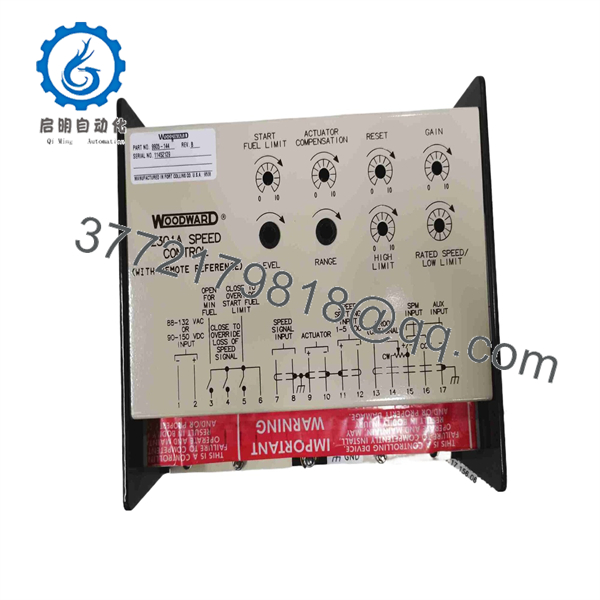
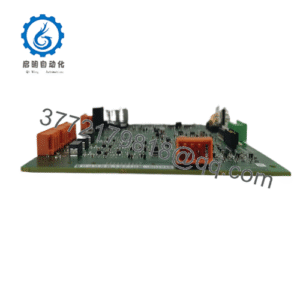
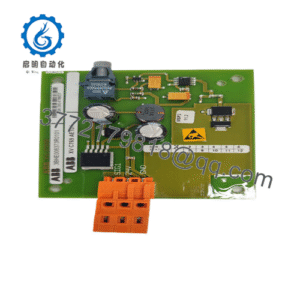
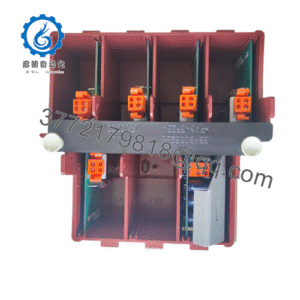
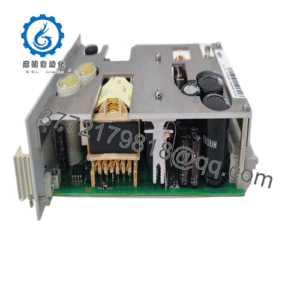
9905-144
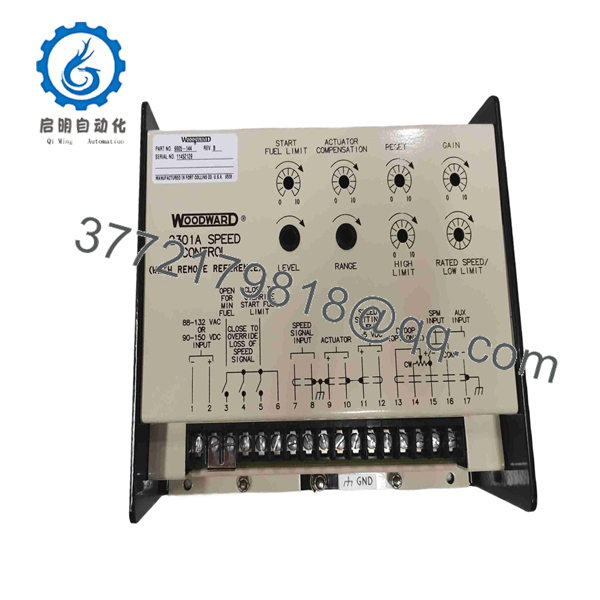
9905-144
Installation & Configuration Guide
Stage 1: Pre-Installation Preparation — About 10 Minutes
⚠️ Safety First: Shut down and isolate the prime mover according to the engine/turbine manufacturer’s procedure. Apply LOTO and prevent an unintended start before touching the controller wiring.
Tools Required:
- ESD strap
- Digital multimeter
- Insulated screwdriver
- Wire labels
- Camera or smartphone
- Approved Woodward 2301A documentation
Data Backup:
- Record the complete 9905-144 part number and revision.
- Photograph the front-panel potentiometer settings.
- Photograph every terminal connection.
- Record the existing 4–20 mA speed reference wiring.
- Record actuator wiring and actuator model.
- Document any externally wired droop or load-sharing connections.
- Record SPM synchronizer wiring if installed.
Stage 2: Removing the Existing Controller — About 5–10 Minutes
- Confirm the prime mover is shut down and secured.
- Isolate the controller’s DC supply.
- Verify the supply is de-energized with a multimeter.
- Label each conductor before disconnecting it.
- Photograph the terminals again immediately before removal.
- Disconnect the speed reference, actuator, power, and auxiliary wiring.
- Remove the controller from its panel.
- Inspect the wiring and terminals for corrosion, loose connections, or damaged insulation.
⚠️ Do not change potentiometer settings on the replacement yet. First record the original settings and establish a controlled commissioning baseline.
Stage 3: Installing the 9905-144 — About 10 Minutes
- Verify the replacement is specifically 9905-144.
- Confirm that the replacement has the same forward-acting configuration.
- Mount the controller securely in the panel.
- Connect the 10–40 VDC control power with correct polarity.
- Connect the 4–20 mA speed-setting signal.
- Connect the actuator wiring according to the applicable Woodward drawing.
- Reconnect droop/load-sharing wiring where applicable.
- Reconnect the optional SPM synchronizer if the installation uses one.
- Tighten all terminals and inspect for stray wire strands.
Configuration Clone — Critical:
- Speed-setting range
- Rated speed
- Gain
- Actuator compensation
- Low idle
- Droop setting
- Load-sharing configuration
- Starting-fuel limitation
- Actuator current limits
The 9905-144 uses a 4–20 mA speed-setting input; do not assume a closely related 2301A model has the same input configuration. Woodward’s manual distinguishes 9905-144 from other variants such as the 9905-148, which uses a different speed-setting input.
Stage 4: Power-On & Testing — About 10–20 Minutes
- Verify the actuator is in a safe state before energizing.
- Apply the controller’s DC supply.
- Confirm the supply voltage is within the applicable range.
- Verify the 4–20 mA speed reference.
- Check actuator output at the appropriate commissioning point.
- Start the prime mover under the approved startup procedure.
- Confirm controlled acceleration to the intended operating speed.
- Verify stable speed in isochronous mode.
- Test droop/load-sharing functions if installed.
- Verify the overspeed protection system independently.
⚠️ Critical: A governor fault can result in loss of speed control. Woodward documentation emphasizes the need for an independent overspeed shutdown device when operating the prime mover.
Frequently Asked Questions (FAQ)
Q1: What is the Woodward 9905-144?
It is a 2301A Full Authority Speed Control, configured as a low-voltage, forward-acting controller with a 4–20 mA speed-setting input and 0–200 mA actuator output.
Q2: What power supply does the 9905-144 require?
The Woodward 2301A documentation specifies 10–40 VDC for the 9905-144. Do not confuse it with higher-voltage 2301A variants such as the 9905-145.
Q3: What is the difference between 9905-144 and 9905-146?
Both are low-voltage 2301A variants with 0–200 mA actuator current and 4–20 mA speed-setting input, but 9905-144 is forward-acting while 9905-146 is reverse-acting.
Q4: Can the 9905-144 operate in isochronous mode?
Yes. The 2301A is designed for isochronous speed control, and droop can be provided through an externally wired potentiometer.
Q5: Does the 9905-144 require an SPM synchronizer?
No. An SPM synchronizer connection is optional. If the installation uses one, the existing synchronizer wiring must be documented before replacing the controller.
Q6: Can I substitute another 2301A model for 9905-144?
Do not assume interchangeability. The 2301A family contains variants with different supply voltages, speed-setting inputs, actuator currents, and control action. Woodward’s documentation explicitly distinguishes these configurations.
Q7: Is 9905-144 still available as a new unit?
Market availability varies. Current suppliers list both new and refurbished examples, while some listings show the part out of stock. The condition should therefore be confirmed in writing before purchase.