WhatsApp: +86 16626708626
 Email:
  Phone: +86 16626708626
Description
Key Technical Specifications
| Parameter | Specification |
|---|---|
| Manufacturer | Yokogawa Electric Corporation |
| Part Number | AAI143-S00 |
| System Compatibility | Field Control Units (FCU) for CENTUM VP & CENTUM CS 3000 |
| Input Signals | 16 Channels, 4 to 20 mA DC |
| Isolation Type | Channel-isolated (Galvanic isolation between channels and to system) |
| Withstand Voltage | 500 V AC between input channels and system backplane |
| Input Resistance | Power ON: 250 Ω, Power OFF: 500 kΩ or larger |
| Accuracy | ±16 µA (±0.1% of full scale) |
| Data Update Cycle | 10 ms |
| Power Consumption | Max 450 mA (5 V DC supply from Fieldnest Node Interface) |
| Environmental Protection | Conformal Coating (-S00 designation) |
| Weight | Approx. 0.35 kg (0.77 lbs) |
Product Introduction & Supply Chain Strategy
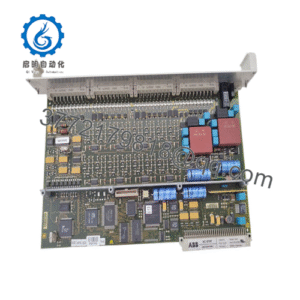
The Yokogawa AAI143-S00 is a 16-channel isolated analog input module for Yokogawa CENTUM VP and CENTUM CS 3000 DCS systems. Unlike non-isolated models, the AAI143 features channel-to-channel galvanic isolation, preventing ground loops, potential differences, and electrical noise interference across field current loops. The -S00 designation indicates standard module operation with factory conformal coating, protecting onboard electronics from corrosive industrial environments (G3 class atmospheres).
Holding an AAI143-S00 module in safety stock is essential for plants operating in electrically noisy environments or processing critical analyzer, flow, and level telemetry. In refineries, chemical facilities, and offshore platforms, a single unisolated ground fault can corrupt multiple I/O channels simultaneously. Refurbished isolated cards frequently carry aged optocouplers or degraded isolation transformers that cause signal drift or loss of galvanic protection over time. Purchasing New Surplus guarantees factory-calibrated measurement precision, intact conformal coating, and zero-downtime protection against lead-time delays.
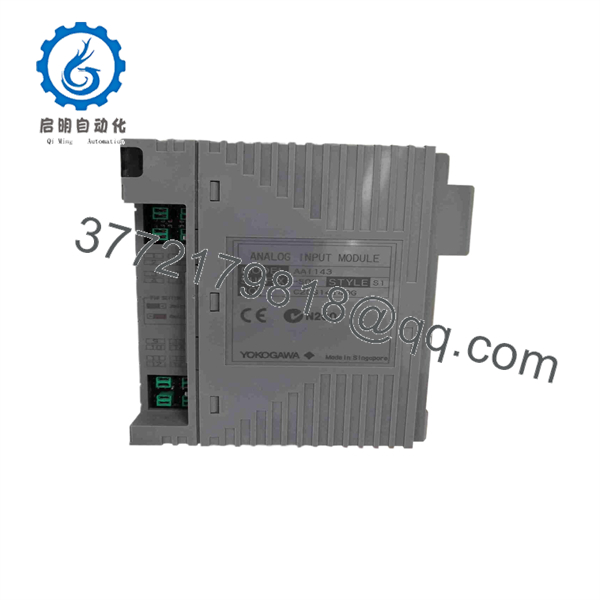
AAI143-S00
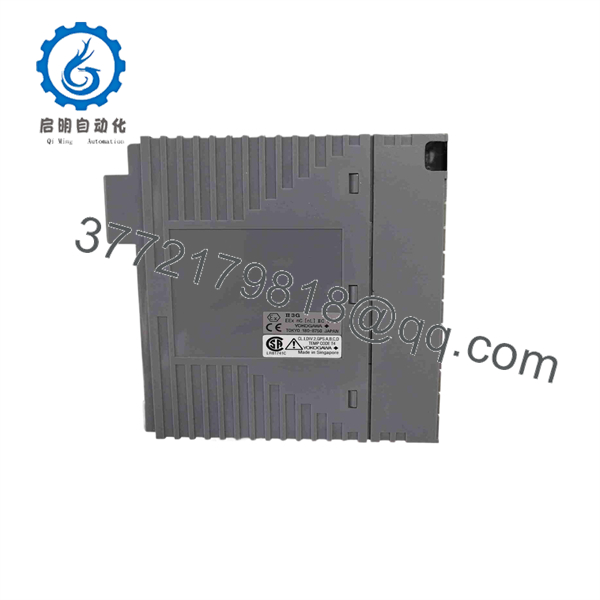
AAI143-S00
Installation & Configuration Guide
1
Stage 1: Pre-Installation (Safety & Loop Prep)
Notify operators, place loops in manual, and put on ESD wrist strap
1.Stage 1: Pre-Installation (Safety & Loop Prep):Notify operators, place loops in manual, and put on ESD wrist strap.
Notify system operators that the target 16-channel I/O module will go offline. Switch all connected control loops into Manual mode or verify fallback safety states in the CENTUM software. Put on a grounded ESD wrist strap before handling the card. Record field terminal block cable routes or disconnect the pressure-clamp terminal block (ATA4D / KS cable interface).
2
Stage 2: Module Extraction
Unfasten faceplate screws and pull module from slot
2.Stage 2: Module Extraction:Unfasten faceplate screws and pull module from slot.
Unscrew the top and bottom captive retention screws on the module faceplate. Slide the original AAI143 module straight out from the I/O node slot along its card guides and place it directly into an antistatic shielding bag.
3
Stage 3: Physical Installation
Verify suffix designation and insert module into backplane
3.Stage 3: Physical Installation:Verify suffix designation and insert module into backplane.
Verify that the replacement module matches the exact code (standard function with conformal coating). Align the card edges with the node card guide tracks and slide the card in smoothly until the rear edge connector firmly seats into the backplane connector. Tighten the retaining screws.
4
Stage 4: Power-On & Loop Verification
Check LED indicators, verify node status, and test current readings
4.Stage 4: Power-On & Loop Verification:Check LED indicators, verify node status, and test current readings.
Re-energize or restore channel activity and check the front-panel status LEDs. Confirm that the green STATUS LED stays solid and no FAIL indication appears. Access CENTUM System View software to confirm node health and perform a loop check across active channels before returning control loops to Auto mode.
Configuration & Suffix Decoding
- Suffix Breakdown (-S00):
- 16-Channel Isolated Analog Input Module (4–20 mA DC).
- -S: Standard Type (Non-HART communication pass-through).
- 0: Always 0 (Standard style).
- 0: Basic type / Conformal coating option (Protection against atmospheric corrosion).
- Comparison vs AAI141: While AAI141 is group-isolated (non-channel isolated), the provides full individual channel-to-channel isolation.
- Dual-Redundant Support: -S00 modules can be installed as dual-redundant pairs in adjacent node slots using dual-redundant terminal blocks or nested cable assemblies.
Frequently Asked Questions (FAQ)
Q: What is the main operational difference between AAI141-S00 and -S00?
A: The AAI141-S00 is non-isolated (group isolated), meaning all channels share a common ground reference is fully channel-isolated, electrically separating each of the 16 channels to prevent ground loops and eliminate noise interference between field transmitters.
Q: Doe support HART protocol communication?
A: No, the -S00 suffix denotes standard analog 4–20 mA operation without HART pass-through. For HART smart device pass-through to Plant Resource Manager (PRM), the or version is required.
Q: Why choose New Surplus over a refurbished module?
A: Channel-isolated cards rely on delicate optical and transformer isolation components. Refurbished modules often suffer from aged isolation components or degraded conformal coatings that compromise electrical protection. New Surplus guarantees factory-level isolation strength and long operational life.
Q: What warranty coverage comes with this module?
A: Every New Surplus Yok card is shipped in ESD shielding packaging with verifiable OEM serial numbers and is backed by a full 1-year replacement warranty.