WhatsApp: +86 16626708626
 Email:
 Phone: +86 16626708626
Description
Key Technical Specifications
| Parameter | Value |
|---|---|
| Motor type | Digital synchronous AC servo motor, 3-phase, permanent magnet, brushless |
| Motor size / length code | 090 / B |
| Winding code | 047 |
| Material number | R911262939 |
| Continuous torque at standstill | 12.0 Nm (convection cooling) |
| Peak torque | 43 Nm |
| Rated speed / Max speed | 3,500 rpm rated / up to 5,000 rpm peak (characteristic speed ~3,200 rpm) |
| Continuous current | 13.2 A (convection) / 16.6 A (surface cooled) |
| Supply voltage | 283–380 VAC |
| Holding brake | 22 Nm holding torque, 24 V DC release voltage |
| Feedback system | Resolver with integrated multiturn absolute encoder, absolute range >4,096 revolutions |
| Shaft design | Plain shaft with shaft sealing ring |
| Flange size | 140 mm |
| Cooling | Natural convection (surface cooling raises output to ~6.4 kW class) |
| Protection rating | IP65 |
| Insulation class | Class F winding |
| Weight | Approx. 14 kg (19.6 lbs) |
| Ambient temperature | 0 to +40 °C (0 to +45 °C operational, derated to +55 °C max) |
| Installation altitude | <1,000 m optimal (derated up to 3,000 m) |
| Drive compatibility | Rexroth IndraDrive, ECOdrive (DKC/DRC), DIAX family drive controllers |
| Typical applications | Machine tools, printing, robotics, heavy packaging, material handling |
Verify the brake rating and your cooling configuration against the Rexroth MKD Project Planning Manual. The 22 Nm brake on this frame is substantial — it holds serious vertical loads — but its release current must be wired through the drive’s brake output, not a hard-wired supply.
Product Introduction
The MKD090B-047-KG1-KN is a large-frame synchronous servo motor from Bosch Rexroth’s Indramat MKD series, aimed at machine tools, printing presses, robotics, and heavy handling axes. The 090 frame delivers 12 Nm continuous torque with natural convection — no blower, no external cooling accessories to maintain.
This unit earns its place in two roles. First, the 22 Nm holding brake holds loaded vertical axes through e-stops and standby, a rating the smaller frames can’t touch. Second, the plain shaft with sealing ring drives friction-locked clamping sets for smooth, backlash-free power transmission. The multiturn absolute encoder tracks position across more than 4,096 revolutions, so a power loss means a restart, not a homing run. On IndraDrive controllers, these motors routinely outlast the machines they’re built into — which is exactly why plants keep sourcing this discontinued frame.
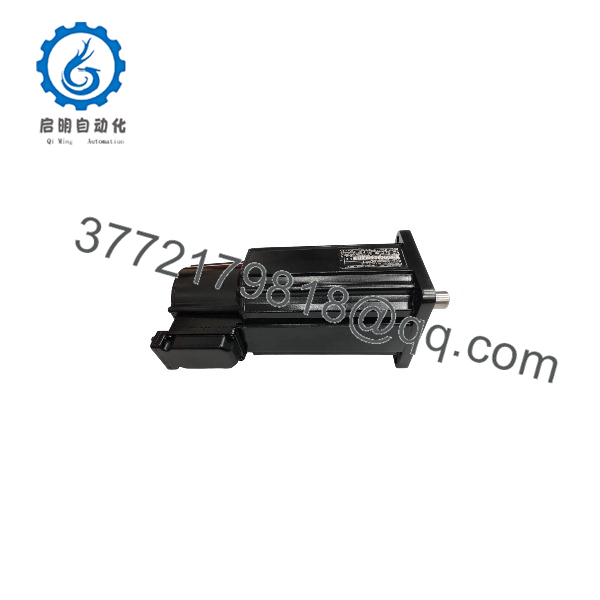
MKD090B-047-KG1-KN
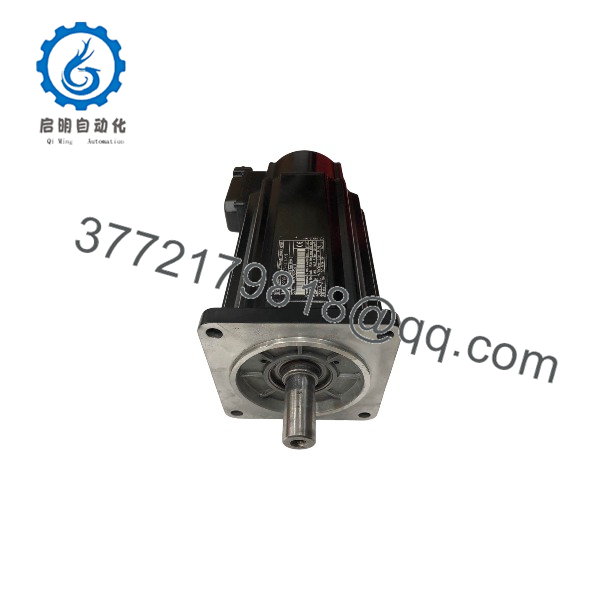
MKD090B-047-KG1-KN
Installation & Configuration Guide
Stage 1: Pre-Installation Preparation (~20 min)
- ⚠️ Safety First: Notify operations of the downtime window. Jog the axis to a serviceable position. This motor weighs about 14 kg and its brake holds 22 Nm — the load itself may exceed both. On vertical or overhauling axes, install a mechanical restraint that carries the full load before you touch anything electrical. Lock out/tag out the drive cabinet, kill the 24 V brake circuit separately, wait 5 minutes for DC bus discharge, then verify the bus reads below 60 V DC with a multimeter.
- Tools Required: Grounded ESD wrist strap, multimeter (Fluke 115 or equivalent), hex key set, torque wrench, dial indicator with magnetic base, cable labels, mechanical load restraint, lifting support for the motor, smartphone for photos.
- Data Backup: In IndraWorks/DriveTop, save the drive’s motor data block and full parameter set. Photograph all connectors, the terminal box wiring, and the cable entry positions. On this frame the power connection runs through a terminal box — photograph every lug and its marking before you loosen anything.
Stage 2: Removing the Old Motor (~25 min)
- Confirm the drive is in torque-off state, the DC bus is dead, and the mechanical restraint carries the load.
- Disconnect the feedback and brake connectors at the motor connectors; open the terminal box and label all power lugs. ⚠️ Photograph the terminal box before disconnecting. Phase sequence mistakes here don’t just run the motor backward — they trip the drive and can damage the output stage.
- Release the clamping set or coupling. Plain-shaft friction locks on a 14 kg motor seize: use a puller, never a mallet, and never pry against the sealing ring.
- Unbolt the flange bolts in a cross pattern. Support the motor’s weight before the last bolt comes out.
- Inspect the mounting face and pilot for burrs; check the new motor’s shaft sealing ring for transit damage.
- ⚠️ Keep the old motor on the bench until the replacement runs clean. Its terminal box layout is your wiring reference.
Stage 3: Installing the New Motor (~25 min)
- ESD strap on. Verify the nameplate reads MKD090B-047-KG1-KN exactly. KG1 = plain shaft with brake; a KP1 has a keyed shaft that won’t fit your clamping set, and a KG0 has no brake.
- Orient the connectors and terminal box to match your existing cable entries before mounting the flange.
- Mount the motor, torque flange bolts in a cross pattern to the MKD manual spec. Apply thread-locker.
- Fit the clamping set or coupling. Check runout with a dial indicator — keep it under 0.02 mm TIR. Torque the clamping set bolts in stages to spec; an under-torqued set slips under peak torque and scores the shaft.
- Terminate power lugs in the terminal box to your photo, reattach feedback and brake connectors. Route the brake lead away from the encoder cable.
- Self-Checklist: [ ] Nameplate matches, [ ] Mechanical restraint still in place, [ ] Terminal box wired per photo, [ ] Clamping set torqued, [ ] Connectors locked, [ ] Brake lead separated from feedback lead.
Stage 4: Power-On & Testing (~15 min)
- Restore the 24 V brake circuit first; confirm the 22 Nm brake releases (a firm, audible clunk on this frame). Then restore cabinet power with the drive disabled.
- Enable the drive. Check the diagnostic block for feedback or phase faults.
- The multiturn absolute encoder should report position immediately — no homing run. If the drive demands homing, do a full power cycle with the feedback connector seated so the drive reads the motor’s data memory.
- Jog at 10% speed. Verify rotation direction against the terminal box photo. Listen for bearing noise; feel the housing for vibration.
- Run a slow full-travel move, then a medium-speed move under reduced load. Verify the brake holds: disable the drive under controlled conditions once and confirm zero axis drift before releasing to production.
- ⚠️ Troubleshooting Note: Encoder fault at power-up means power off fully before reseating the feedback connector — hot-plugging damages the feedback electronics. Reverse rotation means swapped phase lugs in the terminal box. An axis that creeps downward with the drive disabled means the brake circuit is wired hot — fix the brake output wiring before trusting it with a load.
Frequently Asked Questions (FAQ)
Q1: Can I hot-swap this motor under power?
No, and at this frame size the stakes are higher. The IndraDrive DC bus holds lethal voltage after shutdown, the terminal box lugs aren’t rated for disconnect under load, and the 22 Nm brake releases the moment the 24 V circuit drops — a loaded vertical axis falls. Isolate, verify the bus is below 60 V, mechanically block the load, then disconnect. I’ve seen a Z-axis on a large gantry drop 300 mm because someone trusted the brake to hold a load it was never rated for. Block the axis first. Always.
Q2: Is this model obsolete? Is what you’re selling genuinely new?
Yes, the MKD series is discontinued — Rexroth’s successor lines are MSM and MKS. Our stock is New Original / New Surplus: genuine Rexroth production, factory packaging, never placed in service. We verify serial numbers against OEM records as an anti-counterfeit check, inspect for corrosion, rework marks, or UV yellowing, and audit accessories and factory certificates. Photos of the exact unit with its serial number go to you before you commit.
Q3: What’s the direct replacement if this exact unit is out of stock?
Check MKD090B-047-KG1-KS (same motor, different connection housing — plan for a cable set change) or the KP1 variant if your drive hardware uses a keyed shaft. For new machine designs, the MSM series covers this torque class but requires a modern IndraDrive Cs/Ms converter and new cables. Before cross-ordering anything, call us with your drive’s firmware version — the winding code 047 must match the motor data configured in the drive.
Q4: Will I lose my position data or program when I swap the motor?
No. The drive stores the motion logic and parameters, not the motor. The multiturn absolute encoder holds position over 4,096+ revolutions, powered through the feedback connector. One caveat: after the swap, give the drive one complete power cycle with the encoder connected before enabling the axis — it reads the new motor’s data memory on that first cycle. Skip that and you may chase phantom homing demands for an hour.
Q5: Why is your price lower than Rexroth’s original list price?
Rexroth stopped manufacturing this frame years ago. Our stock comes from OEM spares programs, liquidated projects, and factory overruns bought years back. We’re not an authorized Rexroth distributor, and we state that plainly: the 12-month warranty is ours, not Rexroth’s. The trade is factory support — on a discontinued motor — for price and immediate availability. When a 14 kg axis motor dies mid-shift, that trade is easy math.
Q6: The 22 Nm brake seems strong — can I rely on it as a safety device?
As a holding brake, yes; as a safety-rated brake, no. It’s designed to hold the axis at standstill and absorb the residual load during an e-stop. It is not rated for repeated dynamic stopping, and it is not a personal-safety brake under machinery safety standards. If your risk assessment requires a safety-rated holding function (vertical axes over operators, for instance), you need a complementary safety measure — a mechanical restraint or a safety-rated brake system. Don’t paper over that gap with a servo holding brake.
Q7: What quality checks do you run before shipping?
Every unit passes inbound inspection (serial verification, anti-counterfeit screening, visual and accessory audit), then a live bench test on a genuine IndraDrive rack: power-up sequence, resolver/encoder handshake, brake release and engage test at full voltage, insulation resistance check (500 V Megger, >10 MΩ), and a continuous burn-in exceeding 24 hours with thermal monitoring. Results are logged in a signed Test Report; the unit ships in ESD bagging with a QC Passed label and date. Test videos and photos are available on request. We won’t claim it’s failure-proof — we’ll tell you exactly what we verified.